Greenland Security Deal Overhyped as Strategic Triumph
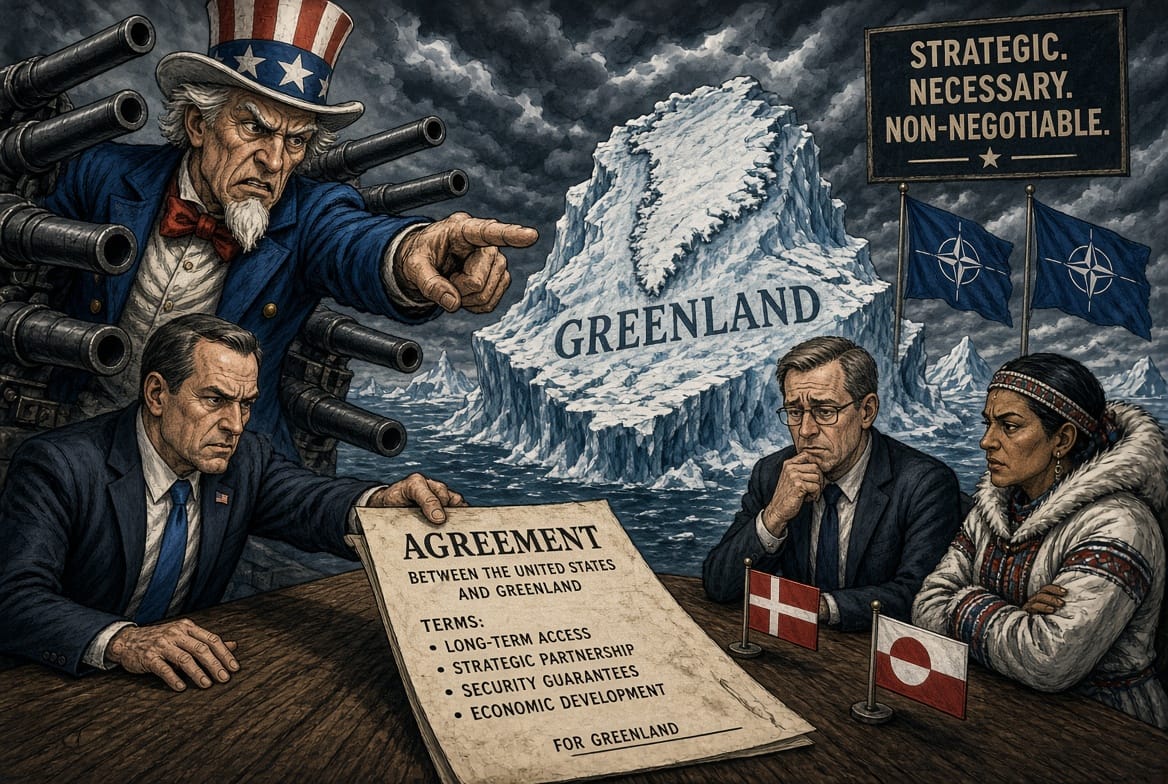
Serey Sam, Phnom Penh/ Copenhagen — The defense agreement signed Sept. 22 by the United States, Denmark and Greenland is being portrayed in some quarters as a decisive American lock on the Arctic’s most critical real estate. A closer examination of the claims shows the deal largely expands longstanding U.S. rights, responds to threats that were never as imminent as suggested, and was extracted under sustained political and economic pressure that undermines its long-term durability.
President Donald Trump described the pact as granting the United States “permanent control” over Greenland’s security needs and blocking adversaries from military presence or sensitive investments. The text allows modernization and expansion at the existing Pituffik Space Base, establishes additional defense areas at Narsarsuaq and Mestersvig, references a potential “Golden Dome” missile-defense system, and formalizes restrictions on non-NATO military installations and certain foreign investments. Denmark and Greenland retain formal sovereignty, and any independent Greenland would remain bound by the arrangement and NATO membership under the agreement’s terms.
Yet the narrative of a transformative win rests on several overstatements.
China and Russia were not racing to establish military bases on the island. Assessments available to U.S. officials and independent analysts found no evidence of Chinese military activity or concrete designs on Greenland facilities. Russian naval and air movements in the broader Arctic have focused more on monitoring the existing U.S. presence than on territorial seizure. China’s Arctic efforts have centered on cooperation with Russia farther east, scientific stations and commercial shipping concepts rather than Greenland bases.
Chinese attempts to secure mineral projects—rare earths at sites such as Kvanefjeld, iron ore and related infrastructure—repeatedly failed or stalled. Greenlandic regulatory decisions, including uranium restrictions, community opposition, high extraction costs and prior informal U.S.-Danish pressure already limited Chinese participation. The new agreement largely codifies restrictions that were already effective in practice. It does not automatically create viable Western mining operations or resolve the commercial and environmental barriers that have kept most projects undeveloped.
Claims of new dominance in Arctic missile warning and defense build on capabilities Pituffik has long provided under the 1951 U.S.-Denmark defense framework (updated in 2004). Additional sites and aspirational language about Golden Dome represent incremental steps rather than a sudden qualitative leap covering Russian ICBM paths, hypersonic corridors or Chinese polar trajectories. Existing NORAD and NATO architectures already leveraged Greenland’s geography.
Assertions of control over emerging Arctic sea lanes similarly overreach. Broader U.S. and NATO maritime awareness already existed, and the bulk of the Northern Sea Route remains under Russian influence. Free movement rights under the earlier agreement already permitted extensive air and sea access.
The “permanent” operational freedom and direct U.S.-Greenland relationship are also qualified. The 1951 pact already granted wide latitude to establish defense areas and move forces. The 2004 Igaliku Agreement gave Greenland a formal voice. The new text clarifies specific locations and processes, but entry into force still depends on Danish and Greenlandic parliamentary procedures, and amendments require mutual consent. Influence over Greenlandic politics is a double-edged prospect: the coercive path to the deal—threats of annexation or force, tariff pressure on European allies, and public demands for ownership—has generated resentment that could empower less cooperative factions over time.
For NATO Arctic allies, the agreement formalizes deeper U.S. engagement and explicit exclusion of non-NATO military presence. It may ease Denmark’s resource constraints. Yet the preceding months of public pressure on a treaty ally damaged trust and cohesion. Shared missile-defense benefits and protection from Chinese investment pressure largely restated trends already underway.
Russia and China face tighter formal barriers to military installations and sensitive economic footholds in Greenland. Those barriers, however, largely institutionalize a status quo in which neither country had realistic near-term prospects for bases or dominant mineral control on the island. Ending “strategic ambiguity” formalizes what Danish policy and the earlier defense arrangements had already made a Western-aligned reality.
The deeper problem is the manner of negotiation. The agreement emerged after months of U.S. pressure that included non-ruling-out of military options, tariff threats against European countries opposing a U.S. takeover, and framing of a NATO ally’s territory as a security imperative that justified exceptional measures. Arrangements concluded under such conditions carry inherent legitimacy deficits. Future Danish or Greenlandic governments, shifts in public opinion, independence debates or changes in U.S. politics can reopen or erode commitments that lack the voluntary foundation of ordinary alliance bargains. “No end date” language does not override that political reality.
The Sept. 22 pact expands useful military access and formalizes investment restrictions. It is not the irreversible strategic masterstroke some portray. Treating it as such while minimizing both its coercive origins and its incremental character produces an incomplete picture of Arctic competition.